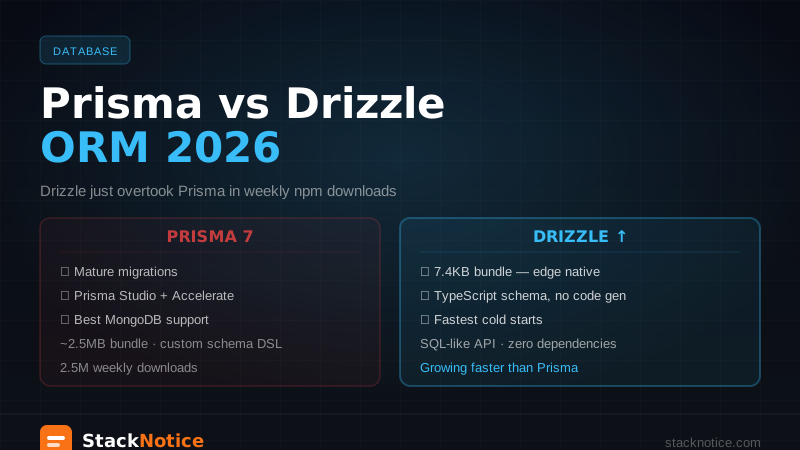
In early 2026, Drizzle ORM surpassed Prisma in weekly npm downloads. That's not a small thing — Prisma has been the default TypeScript ORM for years. Something shifted.
This isn't a post that says "it depends." Both tools have clear strengths and the right answer for your project is usually obvious once you understand the trade-offs. Here's the real comparison.
What actually changed in 2026
Two things happened that reshaped the ORM landscape:
Prisma 7 shipped in late 2025 with the most significant architectural change since v1: the Rust query engine is gone. The entire client is now pure TypeScript. This eliminated one of Drizzle's main advantages — Prisma's bundle size had been massive partly because of that Rust binary.
Serverless and Edge became the default. Vercel, Cloudflare Workers, and AWS Lambda are where most new apps run. Drizzle's architecture (no connection pool, minimal runtime overhead) fits these environments natively. Prisma, even after Prisma 7, still has abstraction layers that add cold-start cost.
The result: Drizzle is winning on the metrics that matter for modern deployment patterns.
The fundamental difference
Prisma is schema-first and generates a client from your .prisma file. You write a custom schema language, run prisma generate, and get a fully abstracted ORM API.
Drizzle is code-first. You define your schema in TypeScript directly. No custom language, no generation step, no abstraction between you and SQL.
// Prisma schema (prisma/schema.prisma)
model User {
  id        String   @id @default(cuid())
  email     String   @unique
  name      String
  posts     Post[]
  createdAt DateTime @default(now())
}
// Drizzle schema (lib/schema.ts)
import { pgTable, text, timestamp } from 'drizzle-orm/pg-core';
export const users = pgTable('users', {
id: text('id').primaryKey().$defaultFn(() => crypto.randomUUID()),
email: text('email').notNull().unique(),
name: text('name').notNull(),
createdAt: timestamp('created_at').defaultNow().notNull(),
});Both produce the same database table. The difference is where you live as a developer — in a custom DSL or in TypeScript.
Performance
Bundle size
| Prisma 6 | Prisma 7 | Drizzle | |
|---|---|---|---|
| Bundle size | ~40MB (with engine) | ~2.5MB | ~7.4KB gzip |
| Runtime deps | Rust engine | None | None |
| Cold start impact | High | Medium | Minimal |
Prisma 7 improved massively. But Drizzle is still an order of magnitude smaller.
Query speed
On raw query throughput, Drizzle consistently runs faster in benchmarks — particularly at the extreme end. For a typical CRUD app, you won't notice the difference. For an API handling 1,000+ requests/second, it matters.
The bigger difference is in serverless cold starts. Drizzle's tiny bundle initializes near-instantly. Prisma 7 is much better than before, but Drizzle still wins on environments where cold starts are frequent (Vercel Serverless Functions, AWS Lambda).
Developer experience
Queries
Drizzle's query API is SQL-like by design:
// Drizzle — explicit, SQL-adjacent
const result = await db
  .select({
    id: users.id,
    email: users.email,
    postCount: count(posts.id),
  })
  .from(users)
  .leftJoin(posts, eq(posts.authorId, users.id))
  .where(and(eq(users.active, true), gt(users.createdAt, lastMonth)))
  .groupBy(users.id)
  .orderBy(desc(users.createdAt))
  .limit(20);
// Prisma — abstracted, readable
const result = await prisma.user.findMany({
where: {
active: true,
createdAt: { gt: lastMonth },
},
include: {
_count: { select: { posts: true } },
},
orderBy: { createdAt: 'desc' },
take: 20,
});Prisma is more readable for simple queries. Drizzle is more powerful for complex joins and aggregations — you're writing SQL concepts directly, so there's no translation layer that hides what's happening.
Type safety
Both have excellent TypeScript support in 2026. The difference:
- Prisma infers types from its generated client. Adding a new field means updating the schema and running
prisma generate. - Drizzle infers types directly from your TypeScript schema. No generation step — change the schema file, types update immediately.
// Drizzle — inferred from schema, no generation
type User = typeof users.$inferSelect;
// { id: string; email: string; name: string; createdAt: Date }

// New field? Just add it to the schema
// Types update immediately, no generate step needed
Migrations
This is where Prisma still has the edge.
Prisma Migrate is mature, battle-tested, and handles complex schema changes well. It generates human-readable SQL migration files and has a good safety story around data migrations.
Drizzle Kit does the job but is less polished. Complex schema changes — like changing a column type or splitting a table — sometimes need manual SQL intervention. The push command is convenient for development but isn't safe for production without review.
# Prisma
npx prisma migrate dev --name add_user_role      # generates and applies migration
npx prisma migrate deploy                         # applies in production

# Drizzle
npx drizzle-kit generate                          # generates SQL migration files
npx drizzle-kit migrate                           # applies migrations
If you work with complex schemas or need the safety of reviewing every migration file before it runs, Prisma's tooling is better.
Serverless and Edge
This is where the choice becomes clear for most new projects in 2026.
Drizzle was built for serverless from the start:
- No connection manager that assumes persistent connections
- Works natively with Neon HTTP driver, PlanetScale serverless driver, Cloudflare D1
- Functions correctly on Edge Runtime (Cloudflare Workers, Vercel Edge Functions)
- 7.4KB bundle doesn't bloat your Lambda deployment
// Drizzle + Neon on Vercel Edge — works perfectly
import { neon } from '@neondatabase/serverless';
import { drizzle } from 'drizzle-orm/neon-http';

export const runtime = 'edge'; // Vercel Edge Function

const sql = neon(process.env.DATABASE_URL!);
const db = drizzle(sql);
Prisma on Edge requires @prisma/adapter-neon or similar adapters, and Prisma Accelerate for connection pooling. It works, but it's more moving parts and Prisma explicitly says Edge support is experimental for some features.
Ecosystem and tooling
| Feature | Prisma | Drizzle |
|---|---|---|
| Prisma Studio (visual DB browser) | ✅ | ❌ (Drizzle Studio is basic) |
| ORM adapters | Postgres, MySQL, SQLite, MongoDB, CockroachDB | Postgres, MySQL, SQLite, Cloudflare D1, Turso |
| Prisma Accelerate (connection pooling) | ✅ | ❌ (use PgBouncer / Neon pooling) |
| Community size | Very large | Growing fast |
| Documentation | Excellent | Good, improving |
| GitHub stars | ~40k | ~25k (growing faster) |
When to choose Drizzle
- You deploy to Vercel, Cloudflare Workers, or any serverless/edge environment
- You want full TypeScript control with no custom DSL
- You're comfortable with SQL and want the ORM to feel like SQL
- Bundle size and cold start performance matter for your use case
- You're starting a new project in 2026
// Drizzle shines here — complex query, full type safety, tiny footprint
const topAuthors = await db
  .select({
    name: users.name,
    email: users.email,
    postCount: sql<number>`count(${posts.id})`.as('post_count'),
    avgViews: sql<number>`avg(${posts.viewCount})`.as('avg_views'),
  })
  .from(users)
  .innerJoin(posts, eq(posts.authorId, users.id))
  .where(gt(posts.createdAt, thirtyDaysAgo))
  .groupBy(users.id, users.name, users.email)
  .having(gt(sql`count(${posts.id})`, 5))
  .orderBy(desc(sql`avg_views`))
  .limit(10);
When to choose Prisma
- Your team is unfamiliar with SQL and wants maximum abstraction
- You need Prisma Studio for database browsing in your workflow
- You're working with MongoDB (Drizzle doesn't support it)
- You need the mature migration tooling for complex schema changes
- You're maintaining an existing Prisma codebase
Migrating from Prisma to Drizzle
If you're on an existing Prisma project and considering migration:
- Don't migrate just because Drizzle is trending. Prisma 7 is good. If it's working, switching costs aren't worth the trend.
- Do migrate if you're hitting cold start issues, bundle size limits, or Edge compatibility problems.
- The migration process: export schema from Prisma, rewrite in Drizzle TypeScript schema, test queries side by side, migrate data with a maintenance window.
The query APIs are different enough that you'll rewrite most database calls. Budget time for that.
The verdict
For new projects in 2026: start with Drizzle. The serverless-first architecture, smaller bundle, direct TypeScript schema, and growing ecosystem make it the better default for modern Next.js apps. Prisma 7 is good but the momentum has shifted.
Exception: choose Prisma if you need MongoDB, you want Prisma Studio and Accelerate in your workflow, or your team strongly prefers a more abstracted API.
Both tools will exist and improve for years. This isn't a "winner takes all" situation — it's a clear segmentation based on deployment target and team preference.
Related: Drizzle ORM in Next.js — Complete Guide · Neon Postgres + Next.js Setup · Database Migrations Without Downtime