The question "will AI replace developers?" is the wrong question. The right question is: which parts of a developer's job are already automated, which parts are becoming automated, and which parts will require human judgment for the foreseeable future?
The honest answer is more nuanced than either the doom camp or the optimism camp admits. AI has already replaced significant chunks of what junior developers spent their time on. It hasn't replaced — and won't soon replace — the judgment that makes a senior developer valuable.
Here's the actual breakdown, based on what's happening in real engineering teams in 2026.
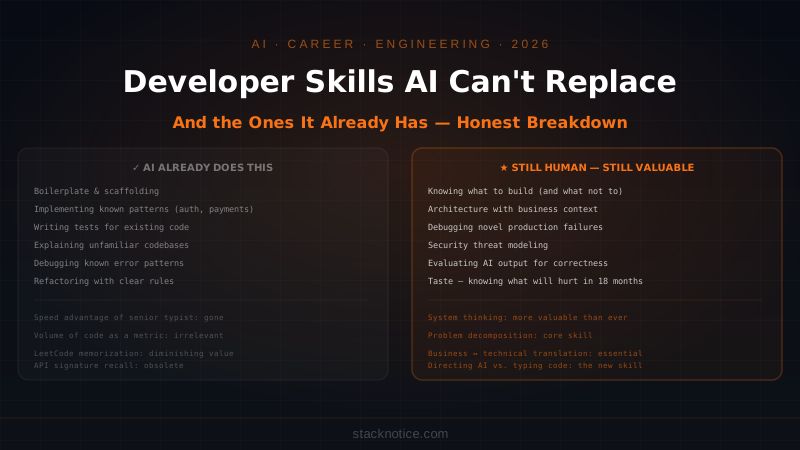
What AI Has Already Replaced
Being clear-eyed about this isn't pessimistic. It's necessary for knowing where to invest your skills.
Boilerplate and scaffolding
CRUD endpoints, form validation, database migrations for known schemas, test setup, component scaffolding — all of this is faster and often better when generated. A developer who spends three hours hand-writing a REST API in 2026 is not being thorough. They're not using their time well.
Claude Code, Cursor, GitHub Copilot — any of these tools will generate a working CRUD API in minutes. The output needs review, but the writing is done.
Implementing known patterns
Authentication flows, payment integrations, file uploads, email sending, rate limiting — these are solved problems. The implementation is documented in dozens of places. AI has read all of it and can produce working code faster than any developer can look up the docs and type it.
This is where the "10x developer" framing of AI assistance is most accurate. A developer who knows what they want and can evaluate what they get moves ten times faster than one writing from scratch.
Explaining unfamiliar code
Dropping an unfamiliar codebase into Claude and asking it to explain what a function does, trace a data flow, or identify what's happening in a complex regex — this works. It's not perfect, but it's dramatically faster than reading code cold.
The developer who used to spend a day understanding a legacy module now spends two hours. That time savings is real and compounding.
Writing tests for existing code
Describing a function's behavior and asking Claude to generate a test suite is one of the highest-ROI uses of AI coding tools. The tests are often better than what a pressed developer writes in a hurry, because AI doesn't get lazy about edge cases when there's a deadline.
What AI Has Not Replaced
Knowing what to build
This is the most underrated skill in software development, and AI doesn't touch it.
A business says they need a "dashboard." AI can build a dashboard. But the question of whether a dashboard is actually what the business needs — whether the problem is data visibility, or process, or that nobody is reading the existing dashboard — requires understanding the context that exists only in human conversation and business knowledge.
The developer who can sit in a meeting, hear "we need to track user engagement better," and translate that into three concrete, buildable features — with an estimate of which one has the highest ROI — is doing something AI cannot do. The business context doesn't exist in the codebase.
Architecture decisions with long-term consequences
AI will help you design a system. It will reason through trade-offs, compare approaches, explain the implications of different choices. What it doesn't have is skin in the game.
An experienced developer knows that the "clever" solution is usually the wrong one three months later when someone else has to maintain it. They've been in the meeting where a technical decision from two years ago is now costing the company six figures to unwind. That scar tissue informs judgment in a way that no training data replicates.
Ask Claude Code to design a multi-tenant data architecture and it will give you several valid approaches. Ask a senior developer who has run a multi-tenant SaaS in production what to actually do, and they'll pick one and tell you exactly what will go wrong with it in 18 months and why it's still the right choice. That's different.
Debugging novel failures
This is the clearest dividing line between AI-assisted development and human judgment.
AI is excellent at debugging known patterns. Stack overflow error in a recursive function, N+1 query in an ORM, race condition in a Promise.all — these have signatures in training data. Claude recognizes them quickly.
AI struggles with failures it hasn't seen before. The production bug that only manifests under a specific combination of load, timezone, and third-party API behavior. The memory leak that takes six hours to appear and disappears when you add logging. The intermittent test failure that only happens in CI.
These require forming and testing hypotheses in an environment you can observe but AI cannot. The developer who can hold five competing explanations in their head, design a minimal test case for each, and systematically eliminate them is doing something that remains fundamentally human.
Security decisions
AI knows the OWASP top 10. It knows what SQL injection looks like. It will tell you to sanitize inputs and use parameterized queries.
What it doesn't know is the threat model specific to your application. Who are your adversaries? What's the actual value of the data you're protecting? Which attack vectors are realistic given your deployment context?
Security decisions require understanding what you're protecting, from whom, at what cost. That's a judgment call that depends on business context AI doesn't have access to.
Evaluating AI output
Here's the recursive skill: using AI tools effectively requires the ability to evaluate what they produce. A developer who can't tell whether Claude's output is correct, secure, and idiomatic is in a worse position than a developer who doesn't use AI at all — they're shipping bugs faster.
The developers who get the most out of AI coding tools are the ones with enough experience to catch the 10% of output that's subtly wrong. Junior developers who rely on AI without the ability to evaluate the output are building on a foundation they don't understand. That debt surfaces eventually.
The Shift in What Matters
The practical implication isn't that AI is good or bad for developers. It's that the distribution of valuable skills is changing.
Skills becoming less valuable:
- Raw typing speed and syntactic fluency
- Memorizing API signatures and library interfaces
- Writing boilerplate from scratch
- Basic algorithmic problem-solving (LeetCode-style)
Skills becoming more valuable:
- Problem decomposition — breaking ambiguous requirements into buildable specs
- System thinking — understanding how components interact at scale
- Evaluation — reading code (AI-generated or otherwise) and knowing if it's right
- Communication — translating between business requirements and technical constraints
- Taste — knowing what good software feels like, not just what works today
The last one is hard to define but easy to recognize. A developer with taste looks at a system and sees the decisions that will cause pain in 18 months. They choose the boring technology that will still be maintainable when they're gone. They push back on features that solve the wrong problem, even when the feature is technically interesting to build.
That judgment isn't in the training data.
What This Means for Your Career
The developers who are struggling in 2026 are the ones who defined their value by output speed — by how much code they could write in a sprint. AI has compressed that advantage significantly.
The developers doing well are the ones who defined their value by outcomes — by whether the right thing got built, in a way that lasts, solving a real problem. AI makes them faster at execution without touching their core value.
Using AI development workflows effectively isn't about replacing your judgment — it's about spending less time on the parts that don't require it, so you have more capacity for the parts that do.
The practical implication: invest in the skills that compound. Understanding distributed systems. Reading code you didn't write. Developing the ability to have the business conversation about what to build before touching a keyboard. Getting good at plan-first development with AI tools — where you direct the build rather than write the code.
The developers who treat AI as an execution layer beneath their judgment are in the best position. The ones who treat it as a replacement for judgment are building a fragile career on an unstable foundation.
The Honest Summary
AI has replaced the parts of development that were always commodities — the typing, the boilerplate, the lookups. It hasn't replaced the judgment that made good developers valuable in the first place.
What's changed is that the commodity work is now visibly commodity. There's no longer anywhere to hide behind volume. A developer who spent 40 hours on implementation work that could have taken 4 is not adding value — they're adding delay.
The freed-up time either becomes room for higher-leverage work, or it becomes visible slack that's hard to justify. The developers who are using that time to get better at architecture, system design, product thinking, and evaluation are compounding their advantage.
The cost of using AI tools well is learning to work at a different level of abstraction. That's genuinely a skill. But it's learnable — and the developers who learn it are finding that the job is more interesting, not less. The parts that remain are the parts that were always the hardest and most valuable.
That's not a bad outcome.